
CVS Specialty — Symptom Tracker
Improving treatment adherence for oncology patients through better symptom communication.
Overview
Patients undergoing oncology treatment often struggle to understand when symptoms require medical attention, leading to delayed care and increased risk.
Role: UX Designer
Timeline: 36 weeks
Team: 2 designers
Platform: Responsive web
Responsibility: Led UX research, interaction design, and prototyping
Problem
User Pain
Patients experience a wide range of symptoms during treatment, but lack clarity on which are expected versus urgent.
System Gap
Existing tools provide limited guidance, placing the burden of interpretation on patients.
Consequence
This uncertainty leads to delayed reporting, increased anxiety, and potential health risks.

Solution
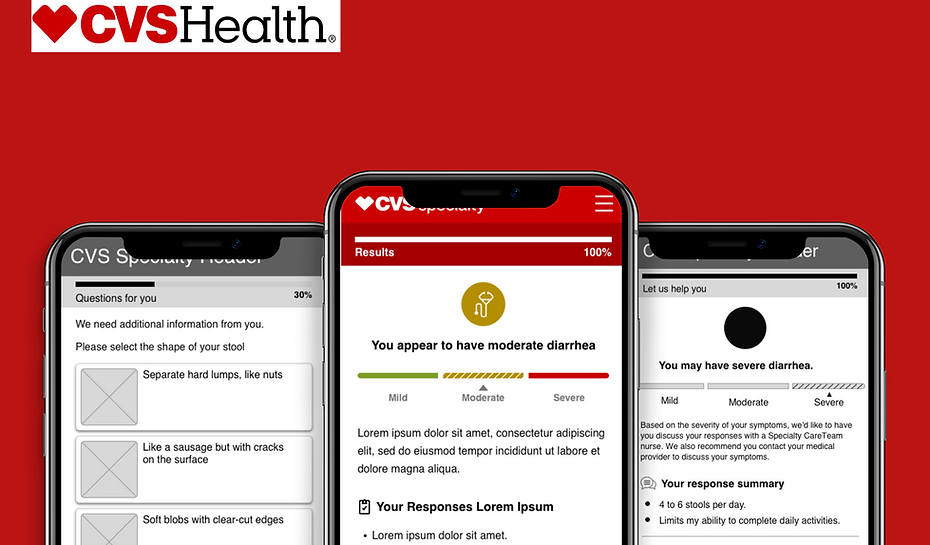
I designed a structured symptom reporting flow that helps oncology patients quickly distinguish between expected and urgent symptoms, reducing uncertainty and improving communication with care teams.
Process
Understanding the Problem
Patients undergoing oncology treatment often experience a wide range of symptoms, but struggle to determine which require medical attention.
To better understand this, I focused on how patients currently interpret symptoms and where confusion or delay occurs in reporting.
Key Insights
Through analysis of the problem space, a few key challenges emerged:
-
Patients lack clarity on what is expected vs. urgent
-
Existing tools rely heavily on patient interpretation
-
Uncertainty leads to delayed reporting and increased anxiety
Exploration & Design Decisions
I reduced cognitive load by replacing open-ended inputs with structured symptom categories:
-
Structuring symptom reporting into guided steps
-
Introducing clear categories instead of open-ended input
-
Using a scale-based interaction to help patients quantify severity
-
Providing contextual cues to reduce ambiguity
Final Direction
The final solution focuses on a guided symptom reporting flow that:
-
Helps patients quickly identify relevant symptoms
-
Clarifies severity through structured input
-
Reduces uncertainty by framing symptoms in context
-
Supports better communication with care teams
Role + Constraints
Role
I led the end-to-end design of a symptom reporting experience to reduce ambiguity and improve patient clarity.
-
Synthesized research to define the problem space
-
Designed user flows and interaction patterns
-
Developed structured symptom reporting concepts
-
Created high-fidelity prototypes
Constraints
-
Ambiguous symptom interpretation
Patients struggled to distinguish between expected and urgent symptoms
-
Limited access to users
Relied on existing research rather than direct interviews
-
Time constraints
Focused on clarity and usability over expanding feature scope
-
High-stakes context
Needed to minimize risk of misreporting symptoms
Design response
-
Simplified choices to reduce cognitive load
-
Replaced open-ended input with structured categories
-
Introduced severity scales to help quantify symptoms
Final Solution
1. Severity Assessment
2. Guided Symptom Selection
3. Contextual Questions


A guided symptom reporting experience that helps patients quickly assess severity and take action.
-
A guided step-by-step flow eliminates guesswork
and helps patients determine when care is needed
-
Structured inputs replace ambiguous reporting
-
Visual severity scales help patients clearly assess urgency
Impact
A structured symptom reporting flow that uses guided inputs and severity cues to help patients make faster, more confident care decisions.
Patients can more clearly distinguish between expected and urgent symptoms
-
Reduces cognitive load during high-stress moments
-
Helps patients describe symptoms more precisely when communicating with care teams
-
Encourages earlier reporting of concerning symptoms
-
Reduced uncertainty during symptom interpretation
Four out of five users consistently reported increased confidence during moderated testing sessions.
Result:
Reflection
This project highlighted how ambiguity in symptom reporting can directly impact patient decision-making in high-stakes healthcare contexts.
-
Breaking complex symptom reporting into guided steps reduced decision friction for patients
-
Replacing open-ended input with structured categories improved both clarity and communication with care teams
-
Working within real constraints forced me to prioritize clarity over feature scope, leading to more focused and practical solutions
If I were to continue this work, I would validate the severity scale and symptom categories with clinicians and patients to ensure medical accuracy and usability at scale.